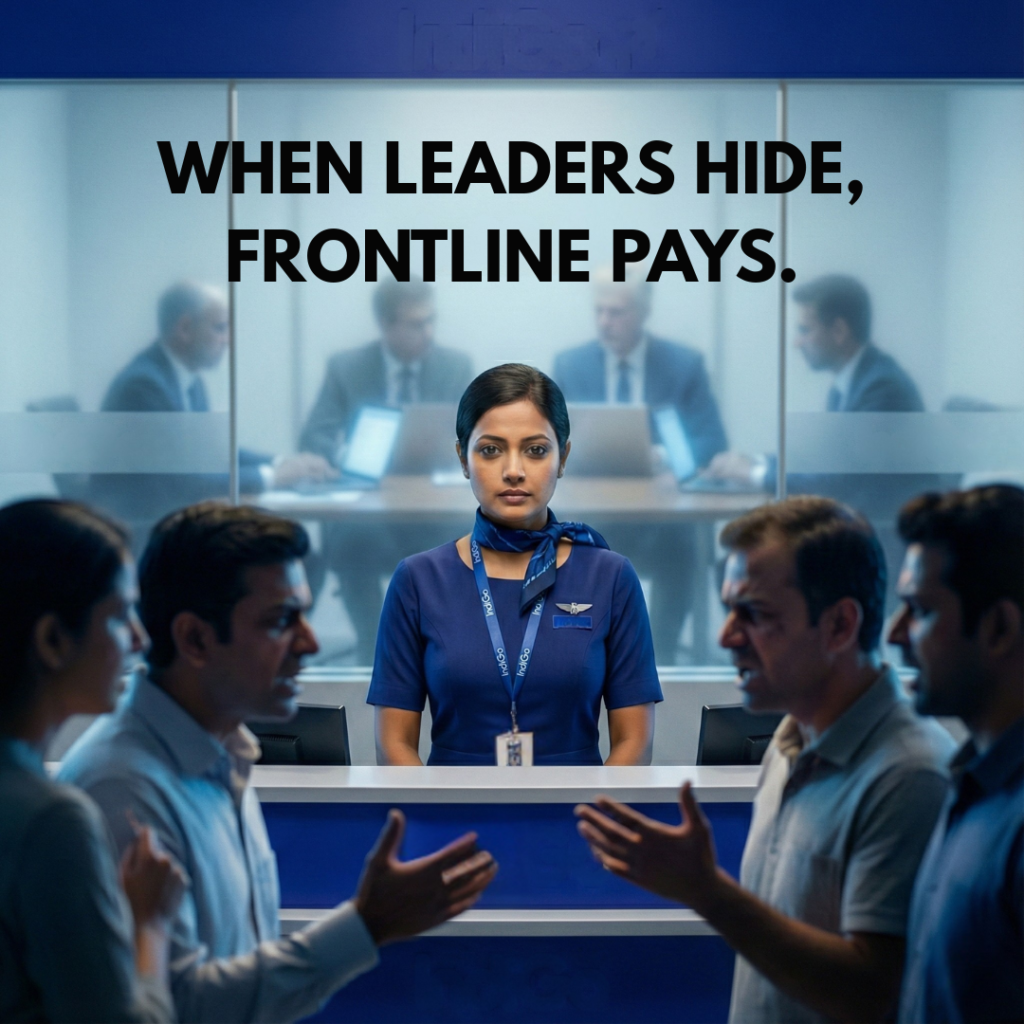
The IndiGo chaos this week was not just about cancelled flights.
It exposed a pattern we see across India, in almost every industry.
The people who suffer the most are almost never the ones who caused the mess.
At the airport, I kept seeing the same scene on my feed:
- Stranded passengers.
- Angry faces.
- Frontline staff standing there, taking punch after punch.
A quick fact-check:
- The frontline did not design the schedule.
- They did not plan crew strength.
- They did not approve the policies.
- They did not roll back regulations.
Yet they became the punching bag for decisions taken in air-conditioned boardrooms.
This is not just an airline story.
You see the same thing in banks, hospitals, call centres, startups, and even government offices.
- Customers shout at whoever is visible.
- Frontline workers absorb the heat and go home burnt out.
- Leadership issues a statement and moves to the “next update”.
Something is broken in how we practice leadership.
If you are a customer
I get the anger. When travel plans crash, emotions are raw.
But the person at the counter is often as helpless as you.
They are running on low information, low authority, and zero protection.
If you are on the frontline
You are the shock absorber of the system.
You don’t get the upside of decisions, but you absorb 100% of the downside.
That is not “part of the job”.
That is a bad design of work.
If you are a leader
A crisis is not the time to “review dashboards”.
It is time to stand next to your frontline and face your customers with them.
If your team is getting screamed at while you sit in a conference room, you are not leading.
You are outsourcing the consequences of your decisions to the lowest-paid people in the chain.
Modern leadership needs a simple upgrade:
- Show up at the front when things break.
- Be physically present. Listen. Talk to customers yourself.
- Not through a PR note. Not through a “we regret the inconvenience” tweet.
- Give your frontline power, not just scripts.
- If they face the anger, they must have the authority to fix things on the spot.
- Otherwise, you are setting them up to fail.
- Share the emotional load.
- If your people go home shaken after a bad day, and you sleep fine, you are missing the point of leadership.
We celebrate leaders for growth, valuations, and market share.
We rarely ask a fundamental question:
Where were you when your customers and your frontline were in pain?
That answer tells me more about a leader than any funding announcement or award ever will.
If you are a leader reading this, the next time something goes wrong in your company, don’t just call for a review.
- Go to the front.
- Stand with your people.
- Look your customers in the eye.
What do you think, as a customer, a frontline worker, or a leader:
Who really pays the price when systems fail?