Your discipline is not weak. It may just be too dependent on mood.
Many people start well. They walk for a few days. Write for a few days. Eat better.
They sleep on time. Make a plan and genuinely feel, “this time I will continue.”
Then one normal day interrupts the streak.
Work stretches. A meeting drains you. Someone says something at home. The body feels tired. The mind feels noisy. And there is no visible result yet.
Suddenly, the same action starts feeling optional.
The walk can wait.
The meal plan can wait.
The page can wait.
The sleep time can wait.
This is where discipline usually breaks.
Not during some dramatic crisis. On ordinary days.
That is where most people lose trust in themselves. One small “not today” at a time.
And because nobody sees it, we also do not take it seriously enough.
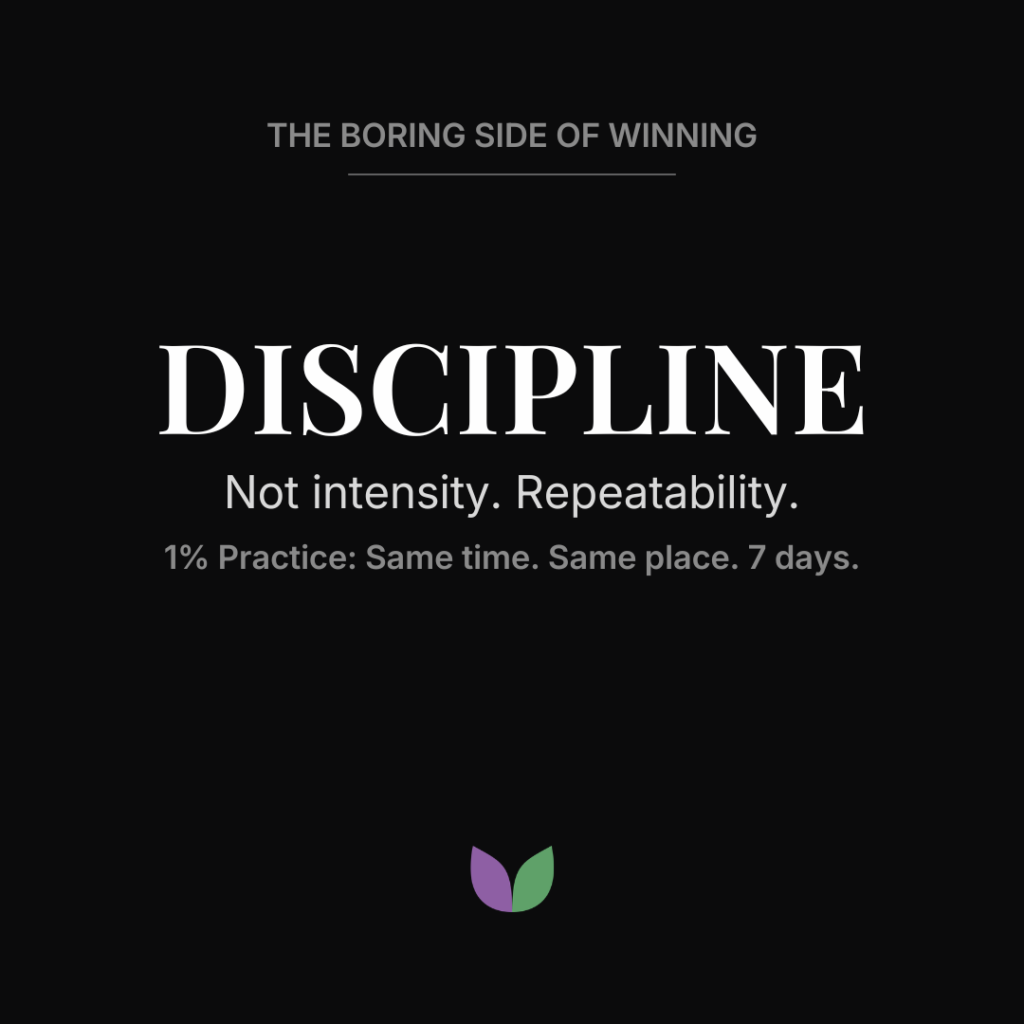
Discipline is not intensity.
It is repeatability.
Why Intensity Fails
Intensity feels convincing in the beginning.
It gives you movement. Makes you feel serious. It creates quick action. For a few days, it can even make you feel like you have finally changed.
But intensity depends too much on mood.
Some days:
You feel sharp.
You feel flat.
Work drains you.
Family needs your attention.
Your mind simply does not cooperate.
If your discipline depends on feeling ready, it will break often.
That is why many people start strong and stop quietly.
They do not always lack commitment.
They lack a repeatable system.
Why Repeatability Works
Repeatability removes drama.
You stop asking, “Do I feel like doing this today?”
You follow the small promise you made to yourself.
It is the walk you still take when the day has been long. It’s the meal you still plan when ordering in feels easier. It is the page you still write when your mind feels scattered. It is the sleep time you still protect when scrolling feels harmless.
Nothing heroic happens in that moment. But something important does.
You keep the promise.
And repeated self-promises slowly become identity.
That is where winning starts.
Not:
On the final day.
When people notice.
When the result looks impressive from the outside.
It starts on ordinary days, when quitting would be easy and nobody would even know.
How to Choose Your 7-Day Action
Do not start with a big life transformation. Start smaller.
A good 7-day action should pass three tests:
- You can do it in 15 minutes or less.
- You can clearly say whether it was done or not done.
- You can attach it to an existing routine.
Do not choose the most impressive action. Choose the most repeatable one.
It could be:
- A 10-minute walk after tea.
- One page of writing before checking messages.
- One fixed breakfast rule.
- Ten minutes of stretching after a bath.
- Sleeping 30 minutes earlier.
- Planning tomorrow before closing the day.
The action does not need to look big. It needs to be clear enough that you cannot fool yourself.
The 7-Day Discipline Practice
Pick the smallest action you keep postponing.
Do it for 7 days.
Same time.
Same place.
No negotiation.
Keep it small enough that skipping it feels dishonest.
That is discipline.
Not fire.
Friction removed.
A Quiet Reflection
Most people do not lose discipline in one big moment. They lose it in small invisible moments.
One postponed walk.
One skipped plan.
One late-night scroll.
One ignored promise.
One “not today.”
And slowly, the real damage is not the missed walk or skipped plan. It is the quiet loss of self-trust.
That is why discipline should not begin with pressure. It should begin with one honest promise that you can keep even on an ordinary day.
At IntuiWell, we believe personal growth does not need more pressure. It needs practical systems that fit real life.
If you keep breaking the same promise again and again, it may not be only a discipline problem. It may be a pattern problem.
Start with one small promise. Keep it for 7 days.
And if the same promise keeps breaking again and again, pause. The problem may not be discipline. It may be the pattern behind it.
FAQ
What is the easiest way to build discipline?
Start with one small repeatable action for 7 days. Keep it simple, visible, and attached to an existing routine.
Why does discipline fail?
Discipline often fails when it depends too much on mood, motivation, or emotional energy.
Is discipline the same as motivation?
No. Motivation is a feeling. Discipline is a repeatable system that works even when motivation is low.