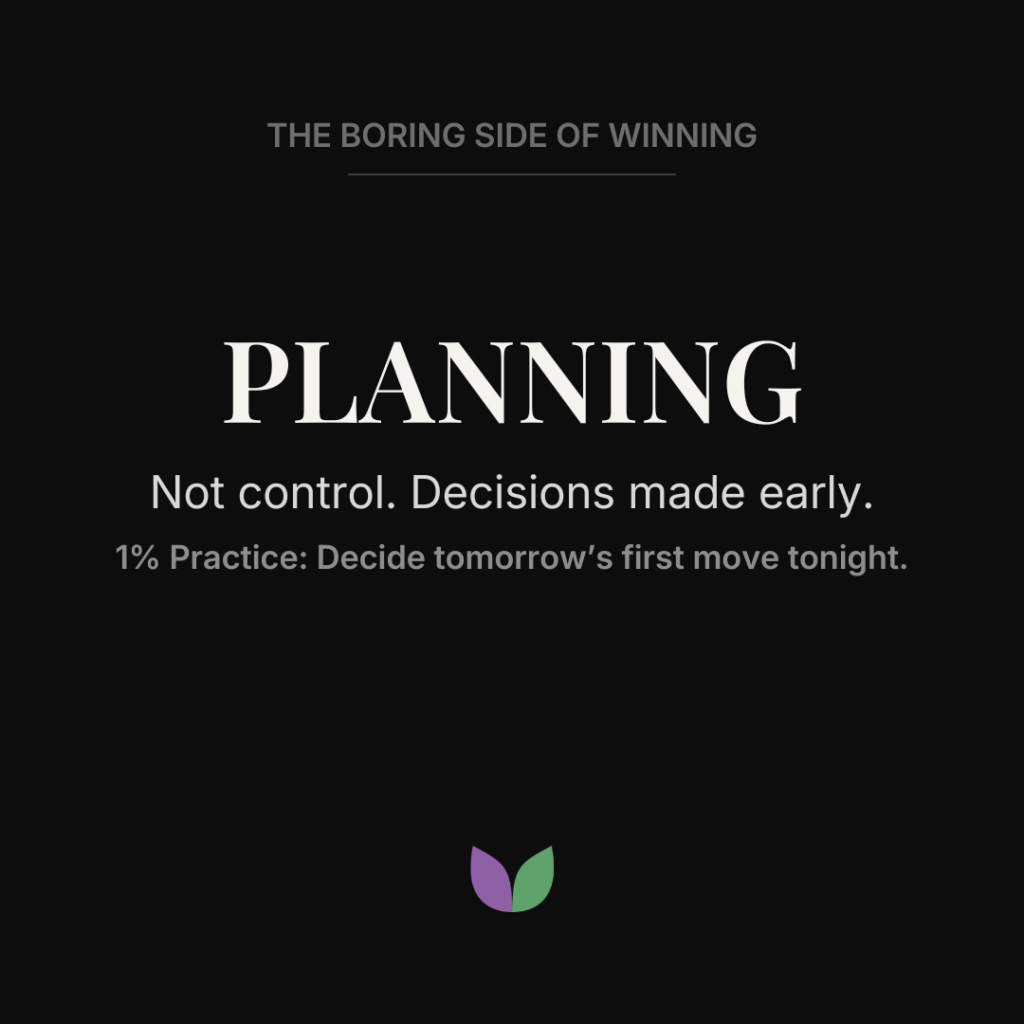
Planning Is Not Control. It Is Deciding Before the Day Gets Noisy.
Most plans fail because too many decisions were left for the tired version of you.
You begin the day with good intentions. You will exercise, complete the important task, eat on time, make the difficult call, and stop working at a reasonable hour.
Then the day gets noisy.
A meeting runs over. Someone needs an urgent answer. An unexpected problem lands on your desk. Your energy drops. By evening, every planned action has turned into a fresh negotiation.
“Should I still do it?”
“Can it wait until tomorrow?”
“Will skipping once really matter?”
This is where many plans quietly disappear. Not because the person stopped caring, but because the decision was left open for too long.
I have seen detailed plans collapse and very simple plans survive. The difference was rarely the quality of the planner or the number of items on the list.
The plan that survived had already answered one practical question:
When the day gets messy, what happens first?
It took me a while to understand this:
Planning is not control. It is deciding before the day starts negotiating with you.
Why Good Intentions Become Daily Negotiations
A goal may tell you where you want to go, but it does not automatically decide what you will do when the day becomes difficult.
“I will exercise tomorrow” still leaves several questions open. What time? For how long? Before work or after work? What happens if the meeting runs late? What counts on a low-energy day?
Every unanswered question becomes a decision you must make later.
That may not look like a problem in the morning, when energy is high and the day still feels manageable. By evening, even a small decision can feel heavy.
This is why people often postpone actions they genuinely care about. They are not always resisting the action itself. They are tired of negotiating with it.
Why Planning Is Not Control
Planning is often misunderstood as trying to make the day obey you.
That does not work. Real life will interrupt even the best plan. Meetings move. People change priorities. Energy fluctuates. Family needs attention. Unexpected work appears.
A useful plan accepts this.
It does not promise that everything will happen exactly as expected. It simply reduces the number of decisions you will have to make while the day is unfolding.
You may not control whether an urgent request arrives. But you can decide that your first 25 minutes will go to the proposal before you open WhatsApp.
You may not control how energetic you feel in the evening. But you can decide that a difficult day still includes a 10-minute walk.
You may not control every disruption. But you can decide what deserves protection before disruption begins.
That is what planning is for.
Not certainty. Less negotiation.
The First Move Practice
Do not begin by planning every hour of tomorrow.
Start with one move.
Before you stop work tonight, decide the first important action you will take tomorrow. Write it in a form that leaves very little room for interpretation:
At [time], after [existing routine], I will [specific action] for [duration].
Examples:
- At 9:30 am, after opening my laptop, I will work on the proposal for 25 minutes before checking WhatsApp.
- At 7:00 pm, after changing out of work clothes, I will walk for 10 minutes.
- At 10:15 pm, after brushing my teeth, I will put my phone outside the bedroom.
- At 8:30 am, after breakfast, I will make the difficult call before opening email.
This is not a complete life plan. It is one clear pre-decision.
That is enough.
A good first move should answer four questions:
- What exactly will I do?
- When will I do it?
- What existing routine will trigger it?
- How long will I continue?
The clearer these answers are tonight, the less negotiation you create tomorrow.
A Quiet Reflection
Many people keep searching for a better planner, a better app, or a more detailed system.
Sometimes those tools help. But the real problem is often simpler.
The important decision was never fully made.
It was left for later, when the mind was tired, the day was crowded, and the easier option was already available.
At IntuiWell, we believe practical growth does not require controlling every part of life. It requires making a few useful decisions before pressure arrives.
Do not plan the perfect day tonight. Decide tomorrow’s first move.
That is planning.
Not control. Decisions made early.
FAQ
Why do daily plans often fail?
Daily plans often fail because important actions remain vague. When the day becomes busy or tiring, each vague action turns into another decision that can be postponed.
How can I plan my day more effectively?
Start by deciding your first important action in advance. Define what you will do, when you will do it, what routine will trigger it, and how long you will continue.
Does planning mean following a rigid schedule?
No. Good planning does not require controlling every hour. It reduces unnecessary decisions while leaving room to adapt when life changes.
What is the First Move Practice?
The First Move Practice means deciding tomorrow’s first important action tonight. It makes starting easier because the decision has already been made.