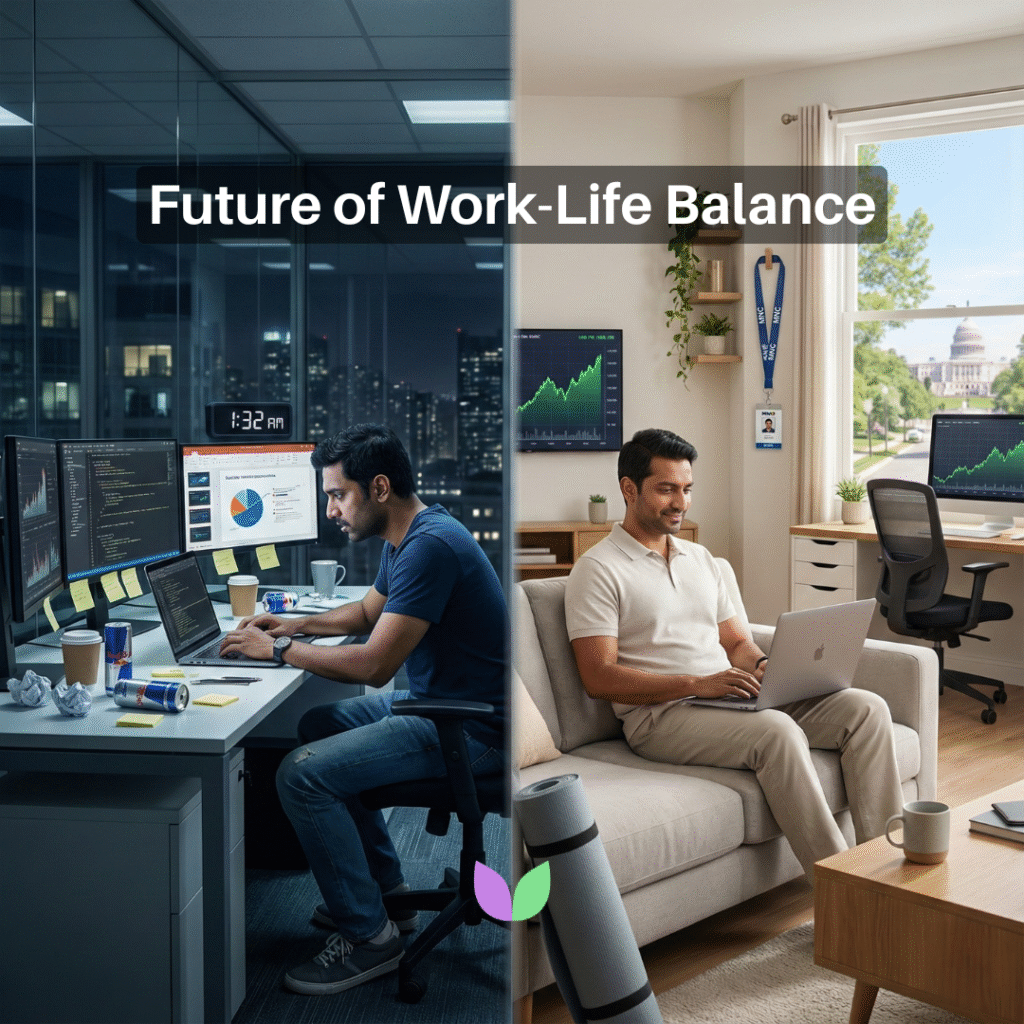
The future of work-life balance in Indian startups won’t be decided by policies or posters — it will be decided by the trade-offs we’re willing to admit.
Stop pretending. Top roles will never have “perfect” Work-Life Balance.
We turned work-life balance into a slogan.
Everyone is using it to sell something.
- Founders use it to look “people-first.”
- Candidates use it to demand maximum comfort with minimum risk.
- HR uses it to decorate policy decks and LinkedIn posts.
Meanwhile, almost no one wants to say the quiet part out loud.
Here it is:
“You cannot chase top 1% outcomes with a “do minimum, feel maximum” mindset.”
And you cannot build a serious company on recycled 1990s hustle porn.
Both extremes are broken.
In India, we’ve glamorised both sides:
On one side:
“70-hour weeks prove you’re committed.”
“If you won’t sacrifice everything, you’re not startup material.”
On the other side:
“I want startup equity, MNC brand, WFH forever, and strict 9-to-5.”
“I want upside like a founder, security like a PSU, and stress like a part-time gig.”
Both are fantasies.
There is no universal, moral, one-size-fits-all work-life balance.
A Founder’s reality is not an entry-level hire’s reality.
A CxO’s reality is not a shift worker’s reality.
Risk, reward, and responsibility are not equal.
So effort will not look equal either.
We keep fighting over the same script:
“Founders have everything at stake, so they work more.”
“You can’t expect employees to bleed when the upside isn’t shared.”
Both are right.
Both are incomplete.
The real questions about work-life balance are:
- What did you sign up for?
- What trade-offs did you agree to?
- Is the system honest about those trade-offs?
- Or is it gaslighting you with “we are all family here”?
Top roles are not “balanced.”
They are deliberately imbalanced over short periods…
with deliberate recovery built in over longer periods.
That’s the real game:
Intense sprints – not permanent burnout.
Real downtime – not fake PTO where you’re still on WhatsApp and Slack.
Clear stakes – not emotional blackmail in the name of “ownership.”
So no, work-life balance in 2025 is not:
“5 days work, 2 days life.”
“3 days office, 2 days home.”
That’s optics. It looks good in policy slides.
If we want something real, we need a different conversation:
Not “How many hours did you work?”
But “What did you sign up for, and is the system brutally honest about it?”
I’ll share the 3 systems that actually replace the time-clock in Part 2 – A New Work-Life Balance Playbook.
Till then, I’m genuinely curious: In your world, where is the bigger delusion, in hustle culture or in comfort culture? DM me.